
Understanding St. Joseph County Releases
A release from the St. Joseph County Jail ends one local custody episode. It does not always put the person back in the community. A person may leave on bond, personal recognizance, a dismissal, time served, sentence expiration, or a court-approved placement. The same jail exit may instead be a transfer to the Michigan Department of Corrections, another county, the U.S. Marshals Service, or immigration custody. The Sheriff booking and release record identifies the physical event. The court docket explains the legal action that allowed or required it.
The distinction matters because St. Joseph County publishes no official online jail roster or recent-release feed. A vanished name cannot be compared with an archived web entry. The direct proof is the inmate jacket, release form, or booking and release log held by the Sheriff. If the disposition says transfer, the receiving agency becomes the next source. If it says bond or court order, the 3B District Court or 45th Circuit Court record supplies the case context.
A person who leaves the county jail may remain confined elsewhere, so confirm both the release type and the named destination.
St. Joseph County Release Types
The release description is a short operational label, not a full account of the case. It must be read with the releasing authority, destination, court number, and later docket entries. The most useful categories separate community release from continued custody.
| Release type | What it means | Best follow-up |
|---|---|---|
| Bond or recognizance | Outside the jail while the case may remain open | Bond entry and next hearing in the court record |
| Time or sentence served | The local commitment ended after credit or sentence calculation | Judgment, jail credit, and release record |
| Court order or dismissal | The Sheriff acted on a judicial direction | Order or certified register of actions |
| Probation or placement | Community supervision or structured programming may continue | Judgment and named supervising agency |
| Transfer | Local custody ended but custody elsewhere continued | Receiving agency and transport record |
| Parole or MDOC discharge | State prison release under supervision, or the end of displayed MDOC jurisdiction | OTIS status, Date Paroled, and MDOC record |
“Case closed” is not a release type. Nor is a booking photo proof of release. Each item answers a different question. The Sheriff shows when the person left the jail, the clerk shows what happened in court, and MDOC shows state custody or supervision.
Note: A treatment placement can be a lawful release path, but its order and program status must be checked separately.
St. Joseph County Release Record Fields
A narrow request is easier to match and review. Use the full booked name, aliases, birth year or date of birth when known, and an approximate booking range. Multiple arrests can produce several custody episodes for one person. The booking number ties the release date to the right episode.
| Field | What it shows |
|---|---|
| Booked name and aliases | The identity used for the jail episode |
| Booking number | The unique link between intake and release |
| Booking date and time | When the local custody episode began |
| Arresting agency | Which office brought the person into the process |
| Court and case number | The case that can explain the legal authority |
| Release date and time | When the Sheriff ended that jail episode |
| Release type or reason | Bond, sentence completion, order, transfer, or another coded event |
| Destination or receiving agency | Whether the person returned to the community or stayed in custody |
| Hold or detainer flags | Whether another authority asserted a custody claim |
Not every field is public or stored in one report. Ask for the code legend if the disposition uses abbreviations. If part of a record is exempt, request reasonably segregable nonexempt material and a citation for each redaction. The booking photograph may be requested for the identified booking, but it documents an arrest image rather than guilt, conviction, or release.
Request St. Joseph County Release Records
The county provides a FOIA information page, a JustFOIA request portal, and a fillable request form. The Sheriff also links a department-specific form from its Forms and Documents page. A letter can work if it identifies an existing record well enough. Ask for records, not an explanation the agency would have to create.
- Identify the person with the booked name, aliases, and another known identifier.
- Give a narrow booking date or date range and name St. Joseph County Jail.
- Request the intake record, release form or log, release timestamp, release reason, authority, and destination.
- Ask for the booking photograph only if it is needed for that exact booking.
- Choose electronic delivery and ask for an itemized estimate before work that will create a fee.
- Request segregable portions and written exemption citations if anything is withheld.
For a certified court explanation, contact the correct clerk for the judgment, release order, probation discharge, or register of actions. The Sheriff cannot certify what a judge meant, and the clerk may not maintain the physical jail exit time. Those are separate records. The county policy says certified copies can be supplied without an added certification charge, but copy and search costs may still apply under law.
Note: The Sheriff can be called at 269-467-9045 at any hour, while record-copy work may follow administrative processing times.
Michigan FOIA for Release Records
Michigan’s Freedom of Information Act, MCL 15.231 through 15.246, provides access to existing public records subject to exemptions. It does not require St. Joseph County to answer a research question or build a new report. Under MCL 15.235, the public body generally responds within five business days by granting, denying, partly granting, or taking one extension of no more than ten business days. A response date is not always the production date.
Fees under MCL 15.234 may include allowed labor, media, copies, and mailing. Paper is limited to its actual added cost up to ten cents per letter or legal sheet. The lowest-paid capable worker generally controls labor, and a deposit up to half of the estimate may be required when the estimate exceeds fifty dollars. Ask for a current itemized estimate. Do not treat jail room-and-board charges as fees for public records.
- Release
- The end of a specific physical custody episode.
- Transfer
- A move to another authority while custody continues.
- Parole
- Conditional release from prison under MDOC control.
- Discharge
- The end of the named sentence or agency jurisdiction.
- Detainer
- A request or legal basis for another authority to assume custody.
St. Joseph Release Property Deadline
The official Jail Information page gives released people a short local deadline. Property must be claimed within 30 days after release or it may be disposed of. Pickup is available any day. A former detainee or an authorized person should call the jail promptly to confirm identity, authorization, and pickup steps before traveling.
This deadline is separate from the time allowed to request a release record. It also does not change the release status. When the Sheriff record appears wrong, ask the maintaining office for the inmate jacket or release form. When the error concerns the legal order, ask the proper court clerk for the certified order or register. Correcting one source may not automatically change another system.
St. Joseph Release Costs After Custody
St. Joseph County posts a room-and-board charge of 30 dollars per day for sentenced county prisoners. The jail page says an unpaid balance may lead to civil action. The Sheriff’s 2023 annual report also describes staff work that tracks room and board and receives booking fees. These financial records may remain after release, but a debt is not a new custody status and should not be described as an independent reason to prolong lawful detention.
A former prisoner should distinguish three kinds of cost: a jail account balance, a court obligation shown in the case, and a FOIA estimate for copies. Each comes from a different authority. The Sheriff can explain the jail account. The clerk can identify court assessments. The FOIA coordinator must itemize a public-record estimate. Mixing the three can lead to a false claim that payment controls release.
Find St. Joseph County Released Inmates
The fastest route depends on the custody system. St. Joseph County has no official roster or release feed, so start with the case and a direct Sheriff check. If the person was sentenced to state prison, move to OTIS. If a transfer or detainer identifies a federal or immigration agency, use that system. Never infer “released” from a search miss.
- Search MiCOURT or the correct local court grid and match more than the name.
- Read bond, release-order, dismissal, sentence, jail-credit, probation, and warrant entries.
- Call the Sheriff and ask whether the person is held now and whether the last event was community release or transfer.
- Request the booking and release record when documentary proof is needed.
- Check VINE for a covered status or alert, then confirm the event with the source agency.
- Follow any named transfer to OTIS, another county, BOP, USMS, or ICE.
A certified order or release document is strongest. An agency release record follows. Official OTIS, BOP, and court records give system-specific proof. Direct confirmation and VINE can supply timely clues. News and third-party material rank last and must be checked against an official source.
St. Joseph County Court Release Clues
Every county criminal case begins in 3B District Court. Misdemeanors finish there, while a felony that is bound over moves to 45th Circuit Court for trial-level disposition and sentence. Useful entries include arraignment, bond, posting, release order, dismissal, plea, sentencing, jail credit, probation, warrant, amended judgment, and discharge. The docket explains authority. It does not replace the Sheriff’s release timestamp.
The official MiCOURT Case Search provides a statewide route to participating courts. The captured search view shows why selecting the right court and matching case facts matters.
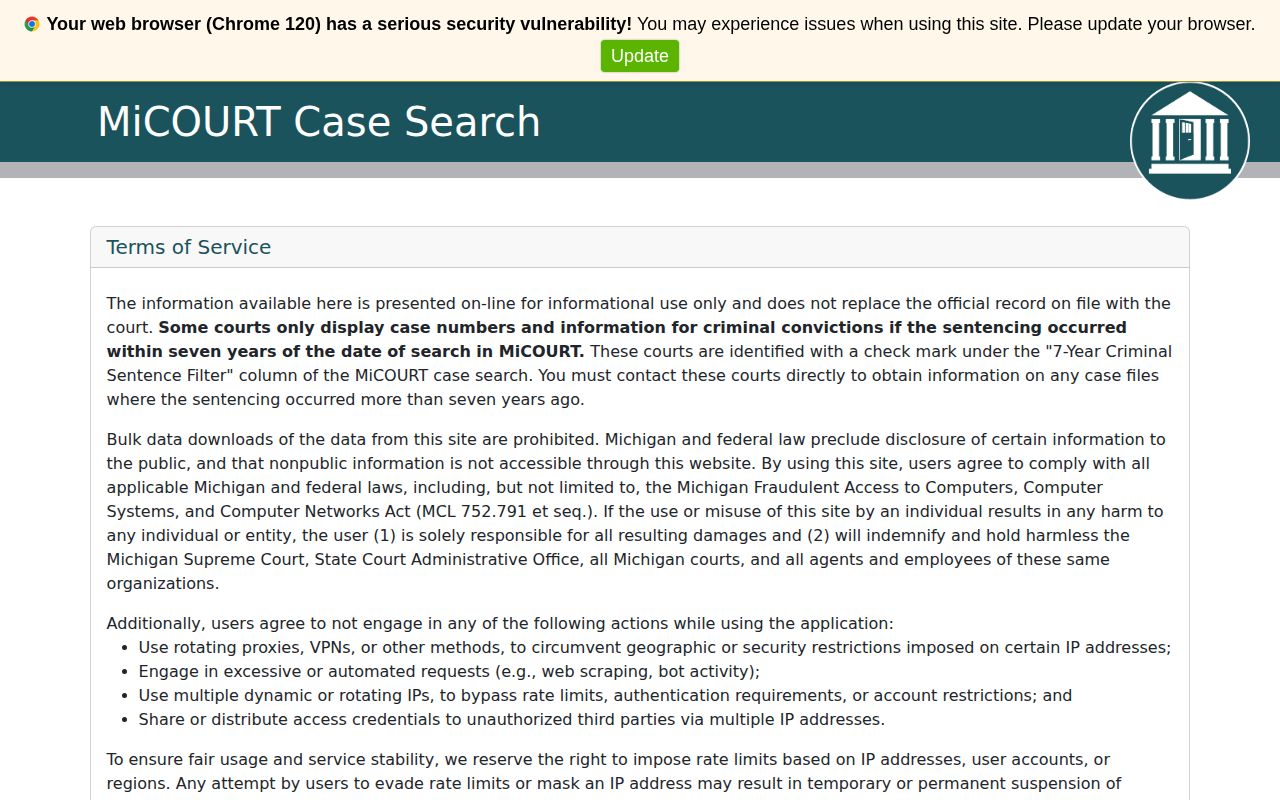
A search-result summary is informational. For firm proof, request the judgment, order, or certified register from 3B District Court or the County Clerk’s Circuit Court Division.
Note: A CLOSED case label does not prove the date or manner of a person’s physical release from the jail.
Older St. Joseph Release Records
Older county cases require extra care. The 45th Circuit Court page warns that its online criminal view covers 2017 forward and says older accuracy must be checked by hand. It also reported that the public criminal terminal was unavailable at the research date. A blank screen is weak evidence, especially for an older person.
The 45th Circuit Court page is the source for that local limit. The page image preserves the access warning that changes how an older release search should be handled.
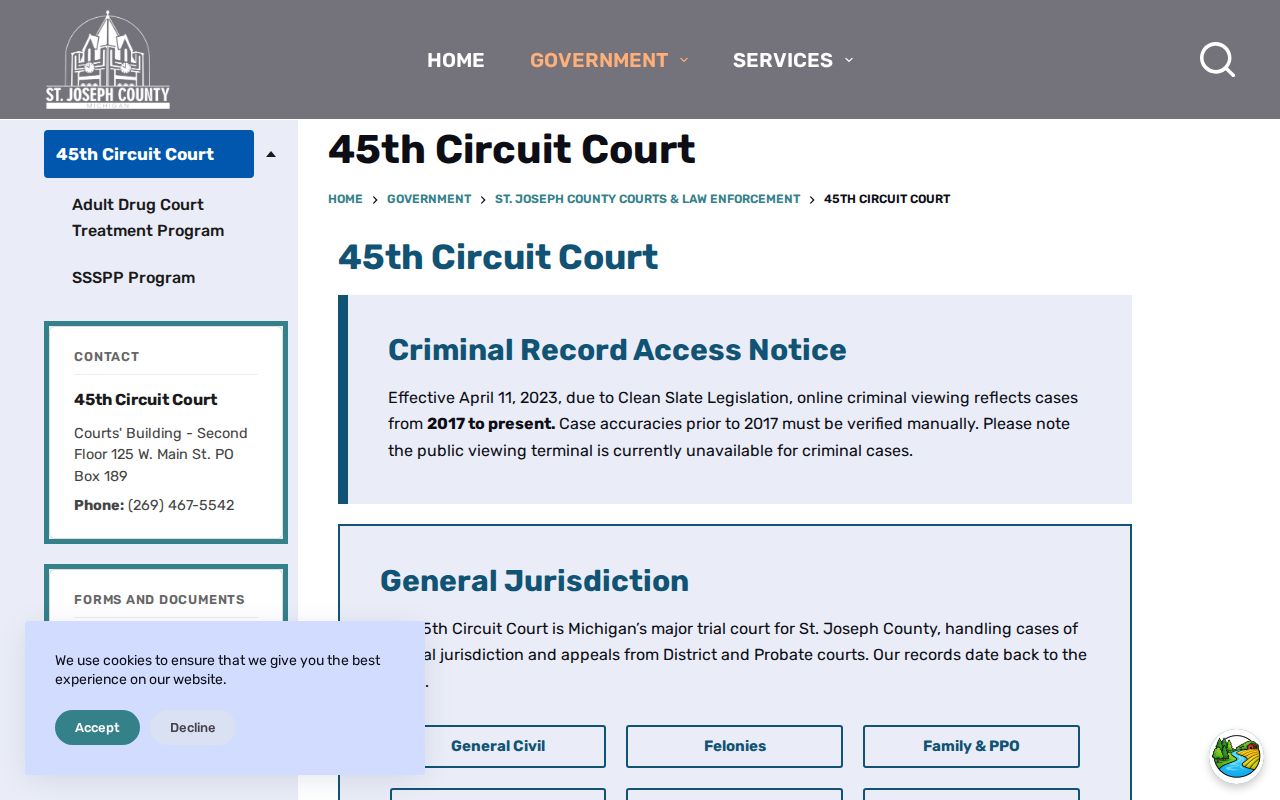
Ask the clerk to check the official record when the online grid has no result. Separately, Michigan’s GS11 general retention schedule describes inmate jackets, booking cards, photographs, transfer papers, and release forms as generally retained until release plus ten years. An approved agency schedule may override that general rule, but it supports a targeted archival request.
MDOC Release Search for St. Joseph
The Offender Tracking Information System, or OTIS, covers people under Michigan Department of Corrections jurisdiction and a limited discharged population. It is not a county booking index. Someone who only bonded out of St. Joseph County Jail may never appear. Search by MDOC number when known. With a name, compare aliases, age, sentencing county, offenses, and dates before accepting a match.
| OTIS field or status | How to read it |
|---|---|
| Prisoner | Still in MDOC prison custody |
| Parole | Left prison under conditional MDOC supervision |
| Probation | Court-ordered community supervision, not proof of prison release |
| Discharged | Displayed MDOC jurisdiction ended, subject to other cases |
| Date Paroled | Evidence of physical prison departure to parole |
| Parole Board Jurisdiction Date | Eligibility milestone, not a promised release |
| Maximum Date | A potential maximum under the sentence calculation |
OTIS generally keeps people public while they are prisoners, parolees, or probationers and for three years after the latest supervision discharge. For certified history, use MDOC records or FOIA. The county jail and MDOC answer different questions.
St. Joseph County Release Notifications
VINELink is Michigan’s public doorway to MI-VINE custody information and alerts. It can monitor release, transfer, or escape events for covered county and state records. Coverage for the particular person and St. Joseph County facility should be confirmed in the live system or with MI-VINE. The service is a status and notice tool, not a certified release document.
For a federal prison record, use the BOP Inmate Locator. A result may show a release date or that the person is not in BOP custody, but later state, local, immigration, or supervised-release status may still exist. ICE’s locator is a conditional path when a release record identifies immigration transfer. A federal pretrial person controlled by USMS may be held in a contract site and may not appear as a BOP prisoner.
Registrable people have one more distinct channel, the Michigan Sex Offender Registry. It covers only people subject to public registration and is not a general release list. A registry status or photo must not be turned into proof of a recent St. Joseph County booking.
St. Joseph Release to Treatment
The Sheriff’s 2022 annual report documents a local release-to-treatment layer. Jail Diversion activity included treatment placements, appointments arranged at release, community-resource handoffs, and some transportation by a Sheriff vehicle to treatment. These entries show that a county release may lead to structured care instead of an ordinary trip home.
The report does not promise a ride or placement to every released person. The court order, release form, and program record still control each case. St. Joseph County Community Corrections also handles pretrial supervision, electronic monitoring, and alternatives to incarceration. Those programs can explain why someone is outside the jail but do not create an MDOC parole status. Details about state supervision belong with the St. Joseph County parole and probation process.
St. Joseph Release and Clean Slate
Michigan set-aside rules can make a release or discharge date important. Under MCL 780.621d, an application waiting period can run from the latest of sentencing, completion of imprisonment, completion of probation, or discharge from parole. A formal release or discharge document may therefore establish part of the timeline. Eligibility depends on the conviction and full history, so no single date proves a person qualifies.
Automatic set-aside under MCL 780.621g has its own limits and periods. Qualifying records can later become nonpublic. An old booking or case that disappears from a web search may reflect Clean Slate treatment instead of an error. Respect sealed, set-aside, juvenile, and suppressed information. Obtain lawful records from the agency that maintains them.
St. Joseph County Release Systems
St. Joseph County’s primary local detention site is the St. Joseph County Jail in Centreville. Sheriff intake or transport, municipal police holding, and Community Corrections are distinct functions. Michigan has no active state prison in the county, though people from county cases may be held in MDOC facilities statewide. Cooper Street Correctional Facility is a Region 8 in-reach service connection, not proof of confinement there.
The same care applies to federal systems. No BOP prison, dedicated ICE detention center, or documented current USMS contract facility was identified in St. Joseph County. Use those pages only when a record names the authority. The right system follows custody, not geography.
- St. Joseph County Jail: Sheriff release record and court order
- Sheriff or municipal holding: agency incident or transport record
- MDOC prison or supervision: OTIS and MDOC records
- BOP sentence: BOP locator and federal judgment
- USMS pretrial custody: federal docket and district office
- ICE detention: ICE locator and ERO contact
Search Public Records
Sponsored Results