
St. Joseph Projected Versus Actual
“Projected release date” is not one universal Michigan field. For an MDOC sentence, OTIS uses specific labels such as Parole Board Jurisdiction Date, Maximum Date, and Date Paroled. The first is an eligibility milestone. The second is a potential maximum under the applicable calculation. Date Paroled is evidence that the person physically left prison for parole.
A pretrial person at St. Joseph County Jail has no sentence-based date to compute. Release may depend on bond, a hearing, an order, dismissal, or another hold. A sentenced county-jail prisoner has a local calculation that must be obtained from the Sheriff and court. A sentenced state prisoner has an indeterminate term with a minimum and maximum, then the parole process applies when legally available.
Find St. Joseph Projected Release Dates
Start with the last authority that has legal custody. A St. Joseph County defendant may leave the county jail for MDOC and still be incarcerated. No active MDOC prison is located in the county, so the physical institution may be elsewhere in Michigan.
- Identify whether the person is pretrial, serving a local jail sentence, or committed to MDOC.
- For MDOC, search OTIS by MDOC number when known.
- Match the result by name, aliases, age information, sentencing county, offense, and sentence.
- Read Parole Board Jurisdiction Date, Maximum Date, status, and Date Paroled as separate fields.
- For county jail, call 269-467-9045 and request the maintained sentence calculation and release record.
- Check the correct court judgment for minimum, maximum, jail credit, amendments, and consecutive terms.
The broader St. Joseph County release lookup helps identify the right court or receiving agency before a date is interpreted.
St. Joseph OTIS Date Labels
The OTIS About page controls the meaning of public date labels. Search results can also show MDOC number, status, location, sentencing county, court, sentence, offense, supervision data, and a photograph. OTIS is not a county booking system, and a local jail-only sentence may never appear.
| OTIS label | Accurate meaning |
|---|---|
| Parole Board Jurisdiction Date / ERD | Earliest point when the Board has jurisdiction to consider parole, not a promised exit. |
| Maximum Date | Potential maximum under the displayed sentence calculation and assumptions. |
| Date Paroled | Recorded physical prison departure to parole supervision. |
| PAROLE | Outside prison under conditional MDOC supervision. |
| DISCHRG | MDOC jurisdiction shown for the sentence ended; read the whole record. |
| Prisoner | The person remains in MDOC prison custody despite county-jail absence. |
The official OTIS search image shows where Michigan sentence records begin.
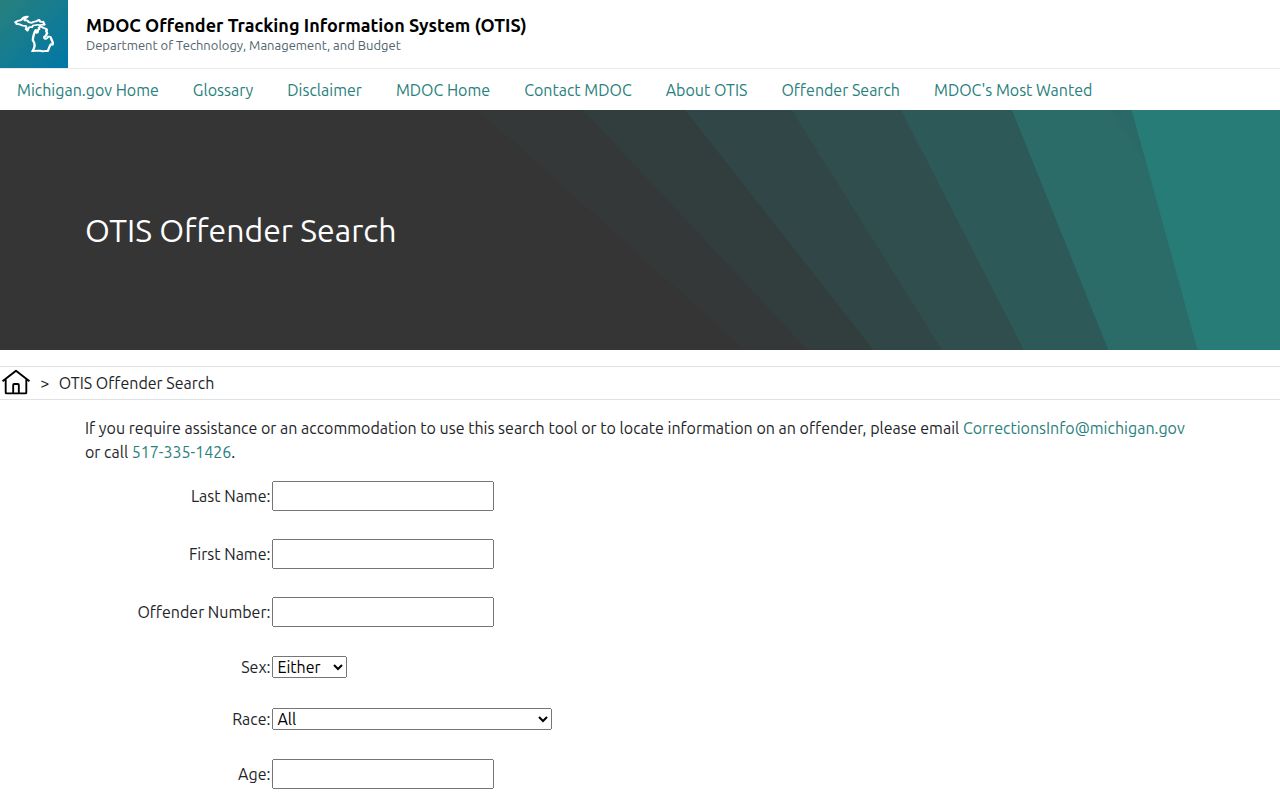
The search must lead to a matched record before any release-date label is used.
Note: OTIS generally removes people from public view after its defined post-discharge period, so an old miss does not erase the sentence.
Michigan Release Dates Are Not 85%
Michigan’s system is not a generic rule that everyone serves 85 percent. The official Truth in Sentencing guidance says covered prisoners serve the full judicial minimum before parole consideration. It applies to specified assaultive crimes committed on or after December 15, 1998 and other crimes committed on or after December 15, 2000.
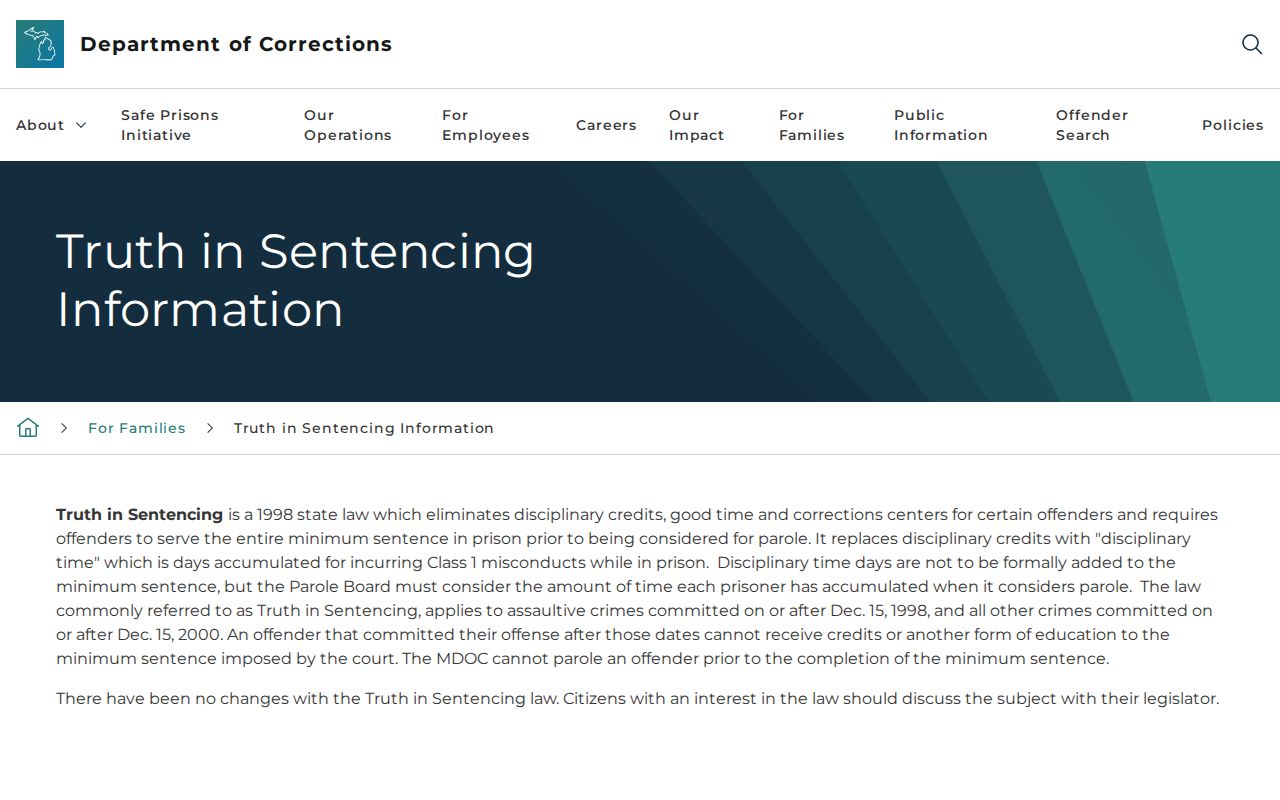
The state page confirms that eligibility follows service of the whole minimum for covered sentences, not an 85-percent shortcut.
The minimum is not the whole indeterminate sentence. Once the minimum is served, parole can be considered if the sentence is eligible. The Board retains discretion. MCL 791.234 governs parole-jurisdiction timing and special categories, while MCL 791.233 adds release criteria.
Legacy offense-date groups can differ. MCL 800.33 addresses good time and disciplinary credits for applicable sentences, while MCL 800.34 addresses disciplinary time for Truth-in-Sentencing prisoners. Never apply a monthly credit chart without confirming the offense date and statutory category.
St. Joseph Jail Credits Differ
County jail credit is separate from the MDOC framework. MCL 51.282 provides a qualifying county prisoner one day of reduction for each six sentence days, subject to the sheriff’s administration, forfeiture, and restoration. MCL 801.4 is also relevant to county jail good time. These statutes do not justify calculating a release timestamp from a calendar at home.
The Sheriff and sentencing court must account for the actual judgment, commitment, jail credit, conduct decisions, holds, amendments, and other lawful terms. Ask for the maintained calculation and the final release form. A posted room-and-board balance is a financial after-effect and should not be treated as an independent basis to extend lawful custody.
Pretrial detention remains different. A person held before disposition does not have a county good-time release date. Bond, recognizance, dismissal, court order, or transfer may end the jail episode.
Why St. Joseph Release Dates Change
A displayed date can move when the legal sentence or the agency calculation changes. The effect depends on whether the date is an eligibility milestone, a maximum, a planned parole departure, or a local jail estimate.
| Factor | Possible effect |
|---|---|
| Amended judgment or resentencing | Changes the controlling court terms and may require a new calculation. |
| Corrected jail credit | Changes credited confinement against the sentence. |
| Consecutive or concurrent treatment | Changes how multiple terms combine. |
| Disciplinary consequences | Can affect credits or disciplinary time where the governing law permits. |
| Parole denial or reconsideration | Leaves the prisoner confined after eligibility and sets later process. |
| Detainer or other sentence | Can lead to another agency’s custody instead of community return. |
| Appeal or database correction | Can change the public date without being a new physical release event. |
A parole grant is still not proof that the gate event occurred. Michigan’s process allows release work after a favorable decision, and adverse information can pause an expected departure. Use the Date Paroled or release certificate.
St. Joseph Parole Timing Evidence
Parole eligibility, a Board decision, and actual release are three distinct events. Under Michigan’s process, the Board reviews eligible cases and applies statutory criteria. A grant authorizes release processing subject to the governing terms. A denial leaves the person confined and leads to later review under applicable practice. A favorable result should not be converted into an exact departure date unless MDOC records confirm that event.
Michigan’s public hearing system also has a narrow scope. Public registration is mainly used for scheduled Lifer Law, commutation, and pardon hearings, not every ordinary parole interview. Quarterly Parole Board decisions reports are aggregate. They summarize grants, denials, and other categories rather than offering a person-level decision lookup. An absence from those public pages says little about one St. Joseph County prisoner.
For an individual case, read OTIS, contact the Board or supervising office through official channels, and request the relevant decision when lawful. The Michigan Parole Board can be reached at 517-373-0270 or Parole-Board-Staff@michigan.gov during posted weekday business hours. Do not treat a hearing date as the release date.
St. Joseph Court Sentence Records
The court record supplies terms that an agency locator may summarize but not explain. Every local criminal matter begins in 3B District Court. Misdemeanors conclude there, while felony cases move to 45th Circuit Court after bindover. A judgment can show the sentence, jail credit, probation, concurrent or consecutive treatment, and later amendments. The register may also show bond, warrants, resentencing, or appellate action.
For a local sentence, ask the Sheriff for the maintained calculation and ask the correct clerk for the judgment or certified register. The 3B District Court Criminal Division is at the Courts’ Building in Centreville and can be reached at 269-467-5627. The 45th Circuit Court number is 269-467-5542. Those sources answer different questions: the court states legal terms, while the jail records the physical custody event.
Online court results are informational. A “closed” label does not mean sentence discharge, and a no-result screen does not prove there was no case. St. Joseph County warns that older Circuit criminal information needs manual verification because its online view has Clean Slate and date limits.
St. Joseph Historical Release Proof
When OTIS no longer displays a person, use records contacts rather than guessing at a date. MDOC says OTIS covers current prisoners, parolees, probationers, and people within a defined period after their latest supervision discharge. A record can fall outside that public period even though MDOC still maintains responsive documents.
The MDOC contact page separates current prisoner records, past prisoner records, and FOIA. It lists Corr_Records_Info@michigan.gov for current prisoner records, MDOC-Records_Retention@michigan.gov for past prisoner records within the stated post-release retention channel, and MDOC-FOIA@michigan.gov for FOIA. Request the existing parole, discharge, or sentence-calculation material needed for the date question.
County-jail records follow another route. The Sheriff’s inmate jacket can include booking cards, sentencing papers, transfer-to-prison records, property forms, and the inmate release form. Michigan’s general GS11 schedule describes those components as generally retained until release plus ten years, though an agency-specific schedule can control. A narrow record request can therefore resolve a past St. Joseph County release after a web search has gone blank.
Note: Certified proof comes from the office that created the judgment, release form, parole record, or discharge action, not from a public search screenshot.
Confirm St. Joseph Actual Release
For a county-jail event, the Sheriff’s record should show the physical release date, time, type, authority, and destination. The court’s judgment or register explains the legal cause. Request both when an exact record is required.
For MDOC, compare OTIS status with Date Paroled or a discharge action, then seek MDOC records for formal proof. The St. Joseph County VINELink check can provide a pending custody-event alert, but the alert is not a certificate and may lag the agency event.
- Eligibility date
- The first legal point for possible consideration, not guaranteed departure.
- Actual release
- The documented physical exit from the named jail or prison custody.
- Parole
- Prison departure under MDOC supervision.
- Discharge
- End of the named jurisdiction, which may differ from the earlier prison exit.
- Detainer
- A claim by another authority that can lead to continued custody.
Federal dates require the BOP locator and federal judgment. Immigration detention uses ICE only when the record supplies that path. Never apply an OTIS date to a federal or county-only sentence.
Public Record Search
Sponsored Results