
Sheriff Holding Release Paths
The Sheriff’s temporary holding and transport role sits before, between, or after other custody events. Deputies may process a person, act on a court order, transport an arrestee to St. Joseph County Jail, or deliver someone to another lawful authority. A person can also leave after an event that permits community release. These paths require different proof.
A release to the community should be supported by the Sheriff’s intake or release entry and, where a case exists, the court order or docket. A transport to the county jail is continued custody. So is delivery to another county, MDOC, the U.S. Marshals Service, or immigration authorities. Ask for the destination and receiving agency. Without that detail, “left Sheriff custody” remains incomplete.
Confirm Sheriff Holding Release
No separate public roster or released-person feed exists for this Sheriff function. Begin with a person-specific call to 269-467-9045. Give the full booked name and an approximate date. Ask whether a county jail booking followed, whether the person was released after processing, or whether another agency received the person.
- Confirm the arresting or transporting unit and approximate event time.
- Ask the Sheriff whether a jail booking number was created.
- Check the correct St. Joseph County court for the legal event.
- Request the intake, transport, and release entries that already exist.
- Contact the named receiving agency if custody continued.
Use at least two identifiers when staff or a portal permits. A common name alone can point to the wrong case. If staff can give only a current-status answer, submit a narrow written request for the historical record. The St. Joseph County released inmates search guide explains how the county, state, and federal paths fit together.
Sheriff Transport Record Fields
The useful record depends on the event. Ask for an existing intake sheet, incident record, transport log, booking entry, release form, or receiving-agency notation. A targeted description helps the Sheriff locate the right file without asking staff to create a new report.
| Record detail | What it can establish |
|---|---|
| Full name and event identifier | Matches the record to the correct person and episode. |
| Intake or arrest time | Places the start of temporary custody. |
| Release or departure time | Shows when Sheriff control changed. |
| Disposition | May identify release, jail booking, court, or transfer. |
| Destination and receiving agency | Shows whether custody continued elsewhere. |
| Court or case number | Connects the physical event to legal authority. |
Some material may be exempt, redacted, or held in a different file. Ask for reasonably segregable nonexempt portions. If the person reached the county jail, the booking and release record becomes the direct custody document. If the person never entered the jail, the incident and transport records may be the better sources.
Request Sheriff Holding Records
St. Joseph County provides an official FOIA page, a JustFOIA portal, a fillable form, and a Sheriff-specific request form through the forms page. Identify the existing record with the person’s name, date or date range, location if known, and arresting unit. State that electronic delivery is acceptable. Ask for the intake and disposition fields, plus the destination or receiving agency when transport occurred.
Michigan FOIA applies to existing public records subject to exemptions. It does not require the Sheriff to answer a research question or create a custom chronology. A response may grant, deny, partly grant, or extend within the lawful time framework. Production can take longer if clarification, review, redaction, or a lawful fee estimate is needed. Request an itemized estimate because there is no fixed fee documented for this exact record set.
Note: Ask for the physical-custody record and court order separately because each office documents a different part of the event.
Sheriff Holding Contact Details
The Sheriff and Jail share the county law-enforcement site in Centreville. The official contact page says telephone access is available at all times. That supports a prompt current-status call, though copies and FOIA processing may still follow administrative workflows.
St. Joseph County Sheriff’s Office
650 E. Main St.
P.O. Box 339
Centreville, MI 49032
Phone: 269-467-9045
Telephone access: 24 hours daily
The official Sheriff page identifies the agency and its divisions. It should be used for agency confirmation, not treated as an inmate locator.
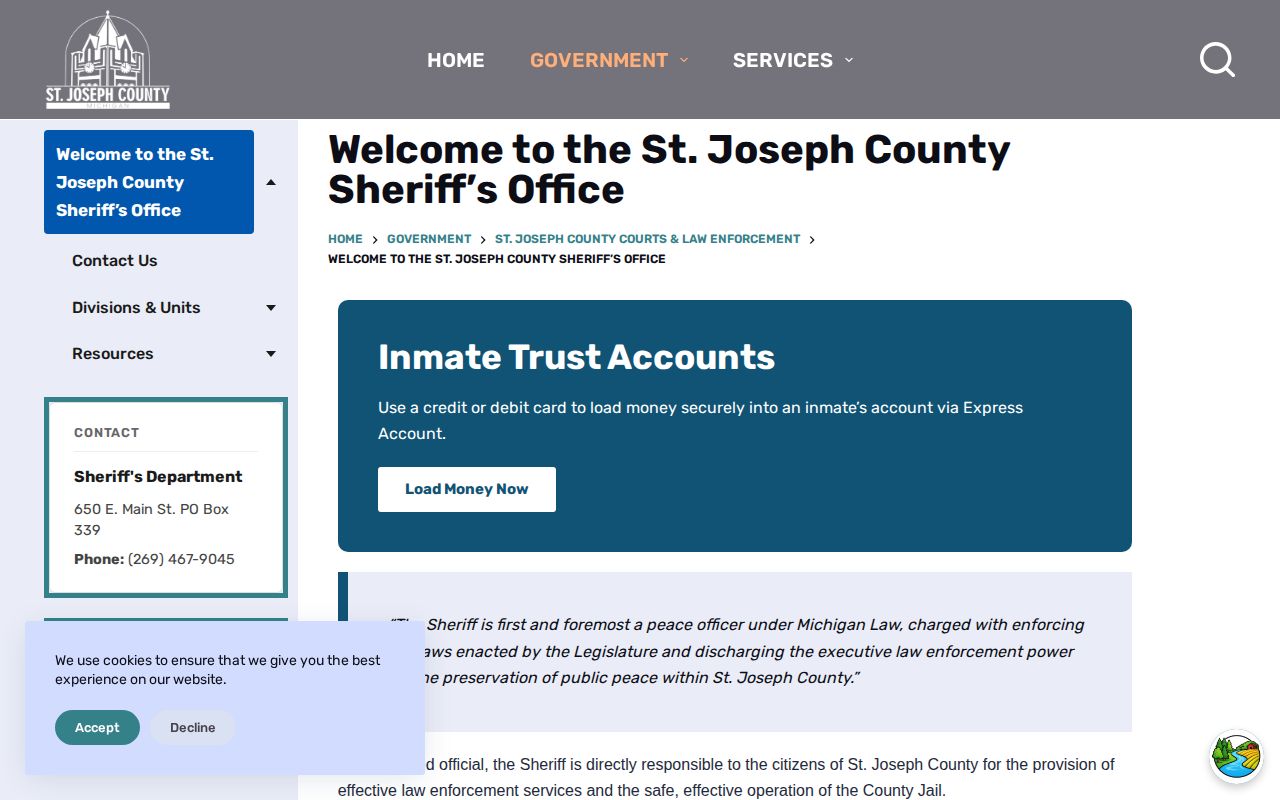
The page helps route a call or request to the responsible county office. It does not show who was processed, transported, or released.
Sheriff Holding Versus County Jail
The Sheriff runs the county jail, but the temporary holding and transport function is not a second jail. This distinction prevents duplicate or false facility searches. If deputies carried the person into St. Joseph County Jail, request the county booking record and use the jail phone line. If a city police agency began the arrest, that agency may hold the incident record even though the Sheriff later holds the booking record.
The Sheriff Corrections page says jail operations run 24 hours daily. It displayed broken zero-value counters during research, so those numbers are not valid measures of capacity, staffing, or annual bookings. The page’s staff description can confirm an active corrections operation, but the absence of a search tool means direct contact and records requests remain the correct route.
Trace Sheriff Transfer Records
A county court docket can show bond, dismissal, warrant, judgment, sentence, or a release order. Every criminal matter starts in 3B District Court. Misdemeanors may finish there, while felony cases move to 45th Circuit Court after bindover. A docket explains legal authority, but it may not record the exact time a transport vehicle departed or another agency accepted custody.
If the destination is MDOC, use OTIS and compare the MDOC number, sentencing county, status, location, and sentence dates. If the destination is another county, call that jail. A federal notation requires the federal docket and the appropriate authority. No general public USMS locator exists. ICE should be checked only when a record supports immigration involvement. These follow-ups keep a transfer from being mislabeled as a release.
Read Sheriff Release Terms
“Bond” or “recognizance” usually means the person is physically out while the case remains open. “Court order” needs the matching docket entry. “Time served” should be read with the sentence and time-served calculation. “Transfer” means the local agency relinquished control to another custodian. “Hold” or “detainer” signals that another authority may take custody when the local basis ends.
Probation is a court-ordered community sentence or supervision and is not the same as parole. Parole is conditional release from an MDOC prison sentence. Discharge usually marks the end of the named agency’s jurisdiction, but another case can remain. Use the exact wording in the record, keep the date it was checked, and avoid turning a search miss into a claim of release.
Preserve Sheriff Release Proof
Keep the source, request number, response date, and exact disposition wording. A phone confirmation can answer an urgent status question, but a saved agency record is easier to compare with the court docket later. If the response says no responsive record, check whether the event belonged to a city police agency or whether the person was booked under an alias. A date range and incident number can help staff find an event that a simple name search missed.
VINE can provide a status clue or notification for a covered record. It does not replace the Sheriff transport or release form, and an alert can arrive after an agency update. For a state transfer, OTIS becomes the next public locator. For a county jail booking, the Sheriff’s booking number should anchor all later requests. These steps preserve a clear chain from temporary holding to the final documented outcome. Keep later court orders with that chain because bond, warrant, and sentence entries can change after the first release.
Sheriff Holding Handoff Checks
The most useful question after a temporary Sheriff event is who accepted control next. If the county jail received the person, ask for the jail booking number and booking time. Those fields create the bridge between the short intake or transport record and the later jail release record. If no booking followed, ask whether a court, hospital, treatment provider, city agency, or another custodian received the person.
A hospital or treatment trip does not always answer the legal-custody question. The person may remain under guard, enter a court-authorized placement, or be released under separate authority. Request the disposition field and the order or agency notation that supports it. Avoid treating the destination alone as proof that all custody ended.
The Sheriff’s 24-hour phone access is well suited to a prompt current-status question. Historical copies follow a different path. Use the county FOIA route and describe the date range, unit, incident, transport destination, and person identifiers. The Sheriff’s annual reports also show that the agency has an administrative FOIA function, but an annual total cannot establish what happened in one case. The individual intake, transport, jail, and court records remain the proof chain.
Public Record Search
Sponsored Results