
St. Joseph Parole Versus Probation
Michigan’s Field Operations Administration is the state starting point, but the source of authority differs. The Michigan Parole Board is the sole paroling authority for people committed to MDOC. A sentencing court orders probation and sets its terms. MDOC may supervise both in the field, which is why an OTIS location can look similar even when the legal status is not.
| Point | Parole | Probation |
|---|---|---|
| How it begins | Conditional departure from an MDOC prison sentence | A sentence ordered by a district or circuit court |
| Decision authority | Michigan Parole Board | Sentencing judge and court |
| Custody meaning | Outside prison but still in MDOC legal custody and control | Usually in the community, sometimes after a jail component |
| Best public check | OTIS status, Date Paroled, and supervision office | OTIS when supervised by MDOC plus the court judgment |
| End record | MDOC discharge action for the sentence | Court or supervising-agency discharge record |
MCL 791.238 describes parole as a permit to leave prison while remaining under MDOC control. That makes a PAROLE result proof of supervised prison departure, not full discharge. Probation may follow a misdemeanor in 3B District Court or a felony in 45th Circuit Court.
Verify St. Joseph Post-Release Supervision
Begin with Michigan OTIS. An MDOC number is more reliable than a name. If only a name is known, compare age, aliases, sentencing county, offense, and location. Read status and date labels exactly.
- Search by MDOC number when possible, or use the full name and narrow the results with available identifiers.
- Open the matching record and read PAROLE, PROB, DISCHRG, ABSCOND1, or ABSCOND2 without substituting a broader term.
- Check the sentencing county, sentence panel, Date Paroled, maximum date, and displayed place of supervision.
- Use the official field-office directory to locate the office tied to St. Joseph County.
- Call that office before relying on a location, reporting date, or cached web result.
- Obtain the parole order, probation judgment, amendment, or discharge record when documentary proof is needed.
OTIS does not cover every county-jail sentence. A person who served only local jail time or received court probation without MDOC jurisdiction may require the court record. The St. Joseph County release search shows how the Sheriff and court routes cover that gap.
Note: A future eligibility or maximum date is not proof that supervision has begun or ended; confirm the actual status event.
St. Joseph Supervision Office Details
The official MDOC Region 8 directory lists the St. Joseph County Parole/Probation office. It shows a permanent Annex 1 location and a temporary Main Street location at the same time. That conflict is a real local issue, not a reason to choose one address without checking.
Courthouse Annex 1, 115 S. Dean St.
Temporary location listed: 125 W. Main St.
P.O. Box 574, Centreville, MI 49032
269-467-5575
Call before visiting
The county map identifies the Michigan Department of Corrections entrance on the east side of Annex I. Active temporary arrangements control, however. A supervision deadline should never depend on an old directory view or an assumed walk-in location.
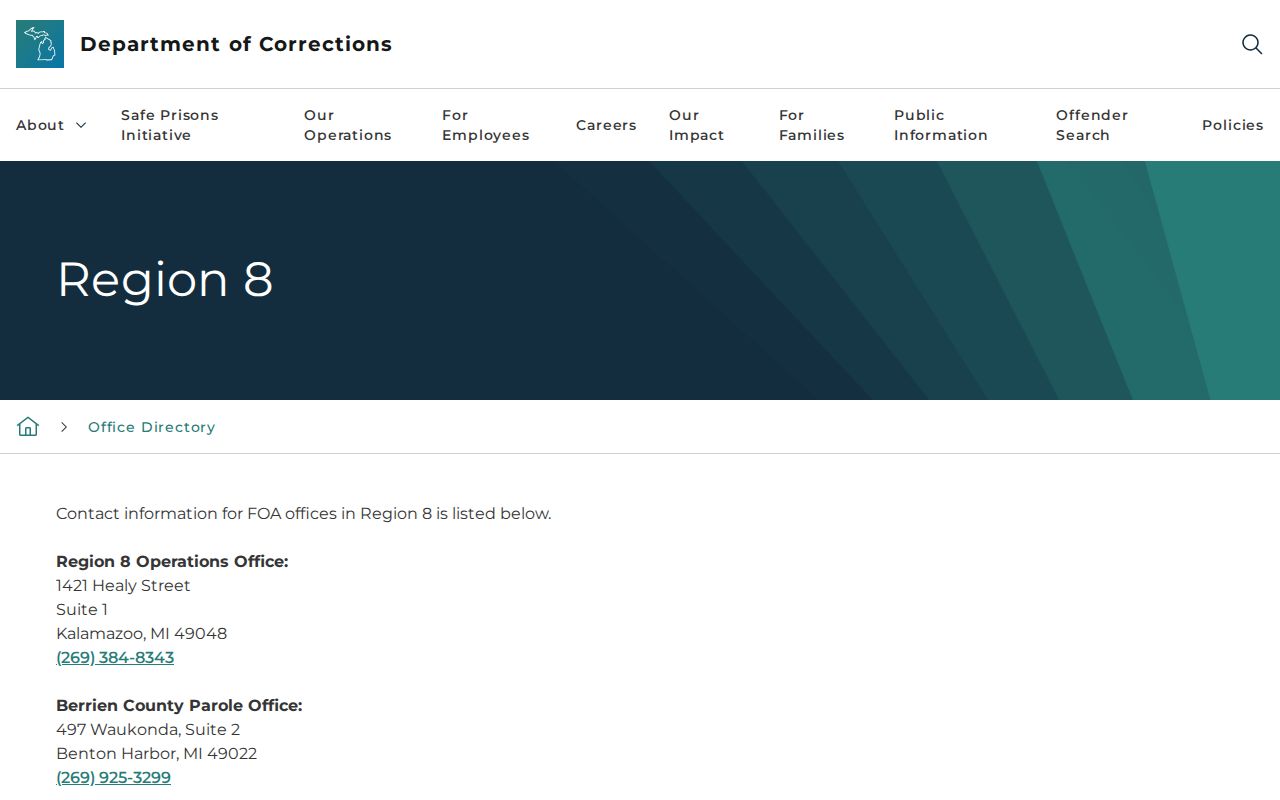
The captured state directory supports calling the listed office before any in-person visit.
St. Joseph Absconder Status
OTIS uses distinct absconder labels. ABSCOND1 means a parole absconder actively sought by MDOC. ABSCOND2 means a probation absconder under the sentencing county’s jurisdiction. Neither status means supervision ended. Neither should be reported as a lawful discharge.
Conditions come from the controlling parole order, probation judgment, and later amendments. They can address reporting, travel, treatment, contact, testing, or other conduct, but no generic list replaces the person’s order. A claimed violation may lead to an investigation, warrant, hearing, changed conditions, revocation, or another result. The docket and agency record should supply the exact action.
MDOC Contact Us lists the Absconder/Escapee Tip Line at 517-755-0855. VINE may provide custody-event notices, but it is not the supervision order and does not replace direct agency confirmation.
St. Joseph Release-To-Treatment Layer
St. Joseph County has a documented local path that is neither parole nor probation by itself. The Sheriff’s 2022 annual report describes jail-diversion activity that included treatment appointments made at release, handoffs to community resources, and some Sheriff transportation to treatment. Those entries show that a person can leave the jail for a structured service connection.
The record does not promise that every released person receives a placement or ride. It also does not identify a public eligibility list. The release order, Sheriff record, and program contact remain the right sources for one case.
The county’s Community Corrections office also describes pretrial supervision, electronic monitoring, and alternatives to incarceration. Its office is on the upper level of the Courts’ Building at 125 W. Main Street, and its phone is 269-467-5606. Community Corrections participation does not create MDOC parole or prove MDOC discharge.
End St. Joseph Supervision
Supervision ends through an official action, not an estimate. For parole, read the discharge action and OTIS status for the displayed sentence. DISCHRG generally means MDOC jurisdiction reflected by that record ended. It can occur at the maximum date without an earlier parole and may have other case-specific context, so the whole record still matters.
For probation, use the sentencing court’s discharge order or register entry and any supervising-agency record. “Case closed” is not a substitute. A case can close while sentence obligations continue, and later violation activity can reopen a matter. MDOC says parole is often supervised for a span of years, but the individual order controls. Do not calculate an end date from the general range.
- Parole
- Conditional prison release under MDOC control.
- Probation
- Court-ordered community supervision, sometimes after local jail time.
- Absconder
- A person alleged to have left supervision without authorization; not discharged.
- Discharge
- The documented end of the named supervision or sentence jurisdiction.
For formal historical records, MDOC lists separate contacts for current prisoner records, past prisoner records, and FOIA. Use the court clerk for a certified probation order.
Document St. Joseph Supervision Status
A current OTIS screen is useful, but it is not a certified supervision file. Save the MDOC number, exact status, location, and retrieval date. If the public result is unclear, call the office listed in the current Region 8 directory. Do not ask staff to reveal a private reporting schedule. The verification question is whether the office supervises the matched person and whether the displayed public status remains current.
When written proof is needed, request a named existing record. MDOC’s contact page separates current prisoner records, past prisoner records, and FOIA. A focused request can seek a parole certificate, supervision order, amendment, or discharge document to the extent it is maintained and public. Michigan FOIA provides access to existing records subject to exemptions; it does not require MDOC to create an explanation. Ask for segregable nonexempt portions if part of a record is withheld.
For probation, ask the proper clerk for the judgment, probation order, amended terms, violation disposition, or discharge entry. A certified court record explains the legal status, while the supervising office confirms current routing. VINE can report a covered custody event, but it does not show the full supervision order. The Michigan registry applies only to people subject to public registration and is not a general parole or probation locator. Use each source only for the question it was designed to answer.
MDOC says parole supervision commonly spans one to four years, but that range cannot be used to calculate one person’s discharge. The individual parole order, amendments, violations, time outside lawful supervision, maximum date, and formal discharge action control. MCL 791.238 explains that a parolee remains in MDOC legal custody and control while permitted outside prison. A Date Paroled therefore confirms the start of supervised release more directly than an eligibility date, while a later DISCHRG status supports the end of the displayed MDOC jurisdiction. Always check for another active sentence or case before describing supervision as fully complete.
Public Record Search
Sponsored Results