
County Jail Release Paths
A person leaving St. Joseph County Jail may walk out under bond, personal recognizance, dismissal, a court order, time served, or expiration of a local sentence. Each event ends physical custody at the county jail, but it does not have the same legal meaning. Bond and recognizance can leave the criminal case open. Probation can begin or continue in the community. A treatment placement may be structured by a court or local program.
Departure can also mean continued confinement. The person may go to the Michigan Department of Corrections, another county, a hospital, a treatment setting, or a federal or immigration authority. The Sheriff’s booking and release record should identify the release type or receiving agency when that field is maintained. A transfer is not a community release. Follow the named agency before drawing any conclusion from the person’s absence.
Confirm a County Jail Release
There is no official St. Joseph County web roster, recent-release list, or Sheriff mugshot app documented in the research. The inmate-funds link is not a custody search. A missing name from an unofficial site proves nothing. Use a person-specific check through the offices that hold the jail and court records.
- Call the Sheriff at 269-467-9045 and ask whether the person is now held.
- If not, ask whether the last jail event was community release or transfer.
- Search MiCOURT or the proper local court for the matching case and order.
- Request the booking and release record for documentary confirmation.
- Follow any named receiving agency through its own official locator.
The phone line is described as available around the clock, though record production may occur during administrative hours. The complete county search and release-record workflow is also explained on the St. Joseph County released inmates home page. Use two identifiers, such as full name plus birth year, booking number, or case number, to reduce the risk of a same-name match.
County Jail Release Record Fields
Ask for the smallest existing record that answers the custody question. A focused request is easier to identify than a demand for every investigative file. Request the booking and release timestamps together so staff can match the correct episode when the person has more than one arrest.
| Field | Why it matters |
|---|---|
| Booked name and booking number | Links the release to one jail episode. |
| Booking and release date/time | Marks the start and end of local custody. |
| Release type or disposition | Distinguishes bond, order, time served, or transfer. |
| Court and case number | Points to the legal record behind the jail action. |
| Receiving agency or destination | Shows whether custody continued elsewhere. |
| Hold or detainer flag | Signals that another authority may have taken custody. |
Not every field is public or stored in one report. Ask the Sheriff to provide segregable nonexempt portions and cite the basis for a redaction. If a coded release value appears, request the code legend. The court clerk, not jail staff, is the best source for a certified judgment, dismissal, bond order, or register of actions.
Request County Jail Release Records
St. Joseph County accepts requests through its FOIA page, the JustFOIA portal, and posted forms. Describe an existing booking and release record rather than asking the county to conduct research. Include the full name, aliases if known, birth year or date of birth, an approximate booking date, and any case or booking number. Ask for electronic delivery if that works for you.
Michigan FOIA generally calls for a grant, denial, partial response, or permitted extension within the statutory response period. That response may precede final production when clarification, review, or a lawful fee estimate is needed. Fees depend on the work and media required, so request an itemized estimate rather than assuming a fixed release-record charge. Michigan’s general GS11 schedule describes inmate jackets, including release forms and booking materials, as generally retained until release plus ten years, but an approved agency schedule can control.
Note: A jail timestamp proves the physical event; the matching court order explains why the release occurred.
County Jail Records Contact
The Sheriff operates the county’s central detention facility. Direct contact is especially important here because the official site has no online roster. Ask the jail status question by phone, then use FOIA when a copy is needed.
St. Joseph County Jail
650 E. Main St.
P.O. Box 339
Centreville, MI 49032
Phone: 269-467-9045
Telephone access: 24 hours daily
The Jail Administrator listed in the source at the research date was Troy Faulk, but personnel can change. Address a record request to the office or role rather than relying on a person’s name. The same Sheriff, Jail, and 911 site uses a shared entrance and parking area, so visitors should review the official directions before going in person.
County Jail Custody Records
The jail holds pretrial defendants, people serving qualifying local sentences, people waiting for transfer, and those held on warrants or other lawful holds. The Corrections division says the operation runs all day, every day, with 24 full-time and four part-time employees, including four corrections sergeants. Broken numerical counters on that page showed zero values during research and are not valid capacity or booking statistics.
The official Corrections page is useful for confirming who runs the operation, but it is not a released-person search. The image below documents the county jail’s official Jail Information page and its post-release rules.
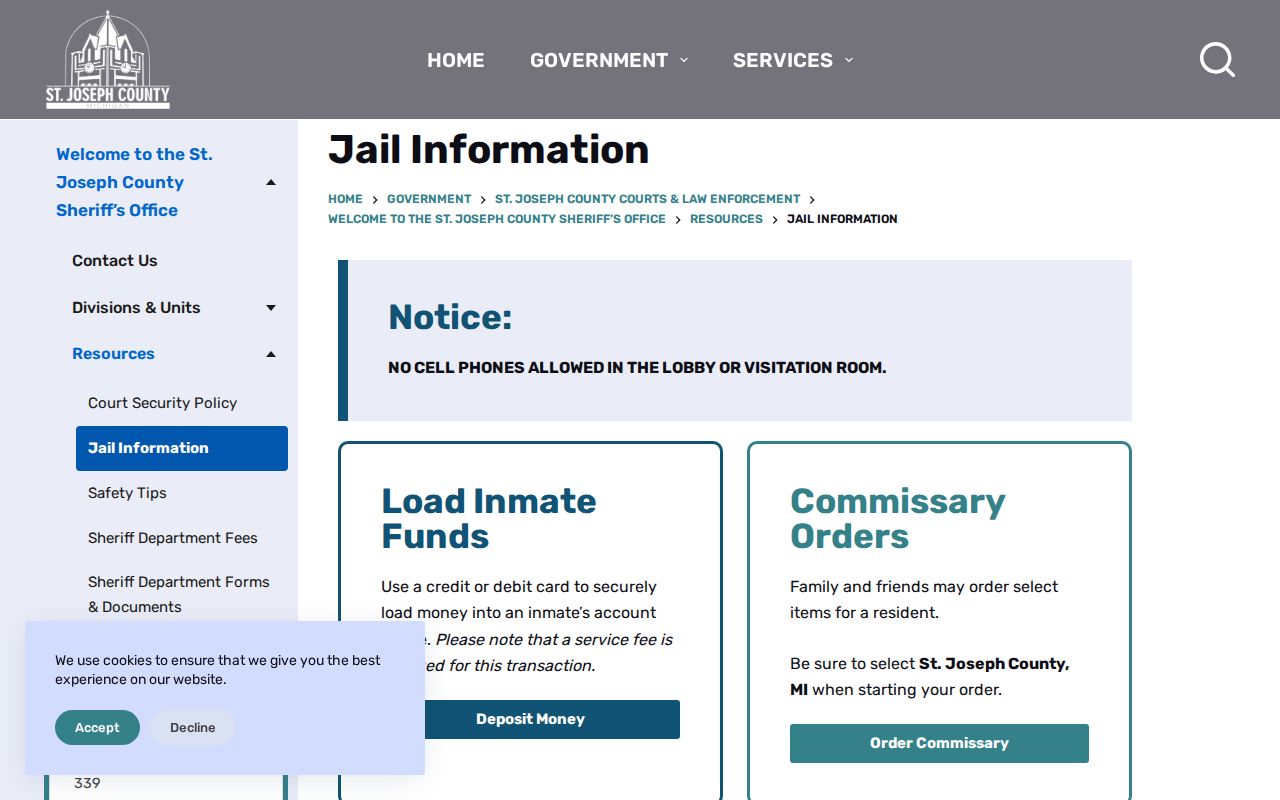
That official page connects the physical jail record with practical steps after departure. It should not be read as a list of people now or formerly held.
Property After County Jail Release
St. Joseph County publishes a specific rule for property left at the jail. A released person has 30 days to claim it before disposal, and the jail says pickup is available any day. The former detainee or an authorized person should call promptly to confirm identity, authorization, and pickup procedures. The rule is a practical deadline, not proof of the date or kind of release.
The jail also posts a $30 daily room-and-board charge for sentenced prisoners and says unpaid balances may result in civil action. That debt issue is separate from custody status. It should never be treated as an independent reason that lawful custody continues. For a dispute about the balance or release entry, ask the Sheriff for the maintained record and the court for the order that governed the sentence.
Verify County Jail Transfer Records
Every criminal matter starts in 3B District Court. Misdemeanor cases can finish there, while felony cases move to 45th Circuit Court after bindover. MiCOURT and the local court grids can reveal bond, judgment, probation, dismissal, warrant, and sentence entries. Older records need extra care because the Circuit Court has warned that its online criminal view is limited for records before 2017.
If the jail record says MDOC, search OTIS by MDOC number when possible. If it names another county, contact that jail. A USMS or ICE notation calls for the federal docket, Marshals district contact, or ICE locator as appropriate. These systems do not replace the Sheriff release record. They answer the next question: where custody went after St. Joseph County relinquished it.
VINE can add a custody-change alert for a covered person, but it is not the documentary release form. Save the event wording and then confirm it with the Sheriff or receiving agency. For a court case, compare the party name, case number, hearing dates, and order. This extra match helps prevent an old event or same-name case from being attached to the wrong custody episode. Keep the date of each search because the live result can change after a transfer, later order, or database update.
County Jail Treatment Releases
St. Joseph County’s 2022 Sheriff annual report documents a local release-to-treatment layer. Its Jail Diversion material describes appointments arranged at release, handoffs to community resources, and some Sheriff transportation to treatment. These figures describe documented program activity, not a guarantee that every person can receive a ride, placement, or appointment. An individual record still needs to show whether treatment was the destination in that custody episode.
A treatment placement can be a true departure from jail while still carrying court terms or program rules. Ask for the release type, authorizing order, destination, and any receiving-program notation that is public. The court docket may show a bond condition, probation term, or order tied to the placement. The jail record should show the physical exit. Neither record should be used alone to assume that the program was completed.
When the former detainee needs property, the published 30-day pickup limit still matters even if the Sheriff transported the person directly to treatment. Call the jail to confirm who may retrieve items and what identification or authorization is required. The annual report does not create a standing transport service, and the jail-information rule does not extend the deadline based on where the person went. Keep release proof, court authority, and practical post-release steps as separate parts of the file.
Public Record Search
Sponsored Results